
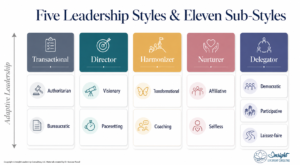
The Five Leadership Styles
(and the Skill that Ties them Together)
By Dr. Karalee Picard
Great leadership isn’t about picking one style and using it forever. It’s about knowing your default style, recognizing the sub-styles, and building the adaptive skills to shift when the moment calls for something different.
Five Distinct Styles, Eleven Real-World Flavors
Most leaders default to one of five recognizable styles, but within each one, real people show up in slightly different ways – which is exactly why each style breaks down into two or three sub-styles. Think of the parent style as the general direction and the sub-style as the particular lane you’re driving in – one you can change depending on traffic.
- Transactional: Leads through order, control, and quick compliance, splitting into Authoritarian (dictates actions and results, empathy absent, unconcerned with relationships) and Bureaucratic (believes in hierarchy, follows procedures, directive to align with policy) – “just follow the procedures and do as I say”
- Director: Sets a clear vision and holds a high bar, splitting into Visionary (embraces vision, strategic thinker, directs people to align to mission) and Pacesetting (fast, deep thinker, leads people to their requirements and to rise to their standards) – “let’s rally together and achieve our vision”
- Harmonizer: Believes progress happens through connection and dialogue, splitting into Transformational (desires to connect people and mission, likely to happen over a long period of time) and Coaching (listens, doesn’t provide many answers, spends time asking deep questions to resolve conflicts)
- Nurturer: Puts people and relationships first, splitting into Affiliative (people first, mission always, listener and wants to partner) and Selfless (meets needs, listener, eager to help others grow) – “your well-being matters, let’s look out for one another”
- Delegator: Distributes ownership and trusts the team, splitting into Democratic (listens to ideas, builds consensus but makes decisions that benefit the organization), Participative (elicits everyone’s input, may take excessive time to decide), and Laissez-faire (trusts the path to success, often introverted, lets others talk first) – “what are your ideas, let’s decide and work on this as a team”
Why the Sub-Styles Matter More Than They Appear
Here’s what the sub-styles actually do: they keep people from rejecting a style label before they’ve had a chance to see themselves in it. Someone who bristles at being called a “Director” because they picture a command-and-control boss might relax the moment they see Visionary described as a strategic thinker who aligns people to a mission, not a person barking orders. Someone uncomfortable with “Delegator” sounding passive might recognize themselves instantly in Participative, someone who elicits input but genuinely struggles with decision speed.
The sub-styles also explain why two people can share the same top-level style and still lead very differently day to day. Two Harmonizers might both believe progress happens through connection, but one leads through long-term relationship building (Transformational) while the other leads through deep, patient questioning (Coaching). Naming that difference gives people language for something they already sensed about themselves but couldn’t quite articulate before.
Adaptive Leadership is the Skill Underneath All Five Styles
It’s tempting to list Adaptive Leadership as a sixth option on the chart, but that would misrepresent what it actually is. The five styles, and their eleven sub-styles, describe what a leader defaults to and how they naturally think. Adaptive Leadership describes something different entirely, which is the capacity to notice what each moment actually requires and then deliberately adapting (or shifting) to a style that fits, even when it isn’t your default style.
A leader who only knows Bureaucratic will struggle the moment a crisis calls for Visionary energy instead of the Bureaucrat’s procedural mindset.
A leader who only knows Selfless may lose a team’s confidence the moment a hard deadline requires Democratic decisiveness instead of endless support people may get used to.
Adaptive Leadership is what closes that gap. It’s not something you are – it’s something you do. You shift every time you read a situation correctly and flex toward the style your team actually needs rather than the one that feels most comfortable to you.
Building Your Own Range
Your default style and sub-style say a lot about your natural instincts, but your growth as a leader gets measured by how many of the other styles you can reach for when your default isn’t the right tool for the moment. The goal isn’t to abandon your natural home base – it’s to build enough range to lead as a Director on Monday, a Delegator on Wednesday, and a Transactional decision-maker by Friday, depending on what your team and your mission need that day.
If you want to find your own default style and sub-style, and start identifying where you need to build range, take the leadership assessment linked below – it’s the first step toward leading with flexibility instead of just leading out of habit.
https://insightlc.org/leadership-styles/
Where to Go from Here
Understanding these five styles, and the sub-styles within them, is the first step. Building the range to move between them under real pressure is a different skill entirely, one that’s much easier to develop with guided practice than by reading about it alone.
If you’d like to explore your own default style and build adaptive range as a team, my workshop “Leadership & Human-Centered Culture” walks groups through this exact framework with hands-on exercises and honest, low-stakes self-assessment.
Reach out if you’d like to bring it to your organization. Karalee@InsightLC.org